Placer County Superior Court serves as the main trial court for the county, handling civil, criminal, family, probate, and traffic cases. It operates within the framework of the California Superior Court system, ensuring that legal matters follow state law and local rules. The court provides residents, attorneys, and businesses with access to hearings, filings, and case management. Its role includes maintaining fair trials, supervising legal procedures, and offering court services to support both self-represented parties and legal professionals. By dividing responsibilities across specialized divisions, the court ensures efficient handling of cases. Each division addresses specific needs, from family law disputes to probate matters. Overall, it acts as the central hub for justice within Placer County.
The court is organized into civil, criminal, family, probate, and traffic divisions, each with clear jurisdiction over relevant cases. Civil matters include lawsuits, property disputes, and small claims, while the criminal division manages felony and misdemeanor trials. Family law covers divorce, child custody, and support issues, and probate handles wills, estates, and guardianships. Traffic and infraction matters are also resolved through dedicated hearings. Residents can file documents, schedule hearings, and access online court services for convenience. The court emphasizes transparent procedures, timely resolution, and professional support to ensure legal matters are resolved efficiently. Its structure and services make it a reliable point of access for all county legal needs.
How to Search Cases & Court Records
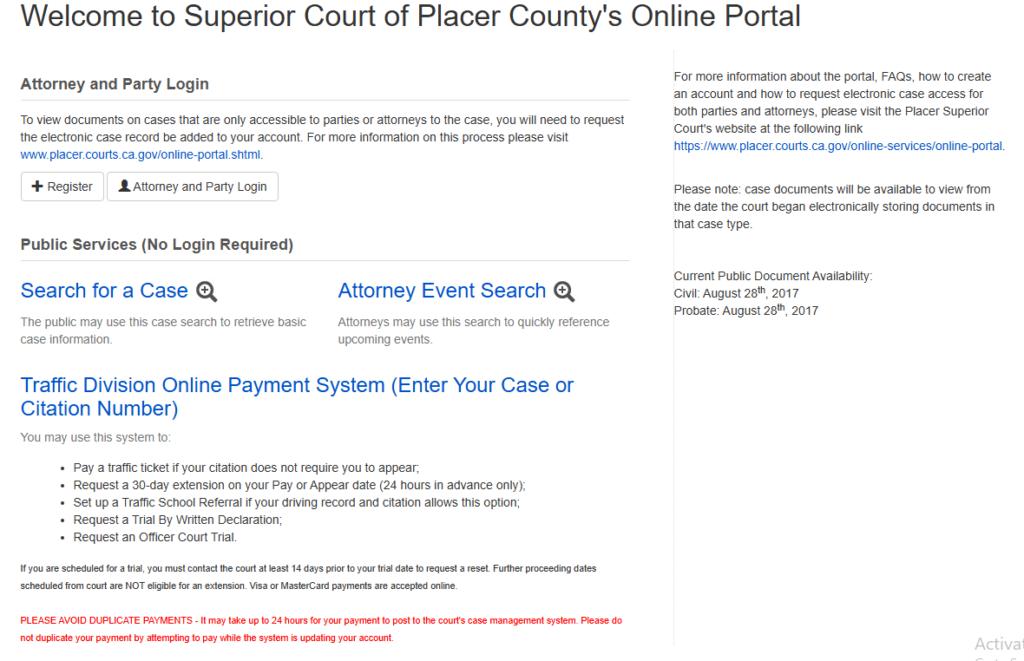
Users can check case status or retrieve official files for matters in the Placer County Superior Court in two main ways: through online case search tools and by submitting public records requests. Both methods give access to court information, whether for personal tracking, legal preparation, or official documentation. Below are clear steps and official links you can use.
Online Case Search Tools
Looking up court cases using the court’s official online systems is usually the quickest option.
Follow these steps to conduct an online case search:
- Go to the official Placer County Superior Court Online Portal: Superior Court of California – County of Placer Online Portal. https://webportal.placerco.org/ecourtpublic
- Accept the terms and conditions if prompted to access public search functions.
- Enter the case number, party name, or citation number in the search field.
- View available results, including basic case details and case status like upcoming hearings or past rulings.
- If needed, filter results by case type (civil, criminal, family law, probate, traffic) to narrow your lookup.
Public Records Requests
If you need official files, certified copies, or records not fully accessible online, you can request them directly from the court. Public records requests allow access to certified copies and official documentation not always provided through online search tools. Certified copies are often needed for legal use, filings with other agencies, or formal evidence. Using Placer County Records residents and attorneys can efficiently search cases and court records in Placer County. Online tools are great for quick lookups, while formal requests ensure access to official file copies for legal and administrative needs.
Here’s how to proceed:
- Decide what specific documents you want — for example, certified copies of judgments, filings, or full case files.
- Visit the Case Records & Copy Request section on the court’s official site to view policies and available forms.
- Complete the appropriate request form (online or mailed) with details about the case and the type of record you need.
- Pay any copy or certification fees required at the time of processing.
- Submit your request by mail or in person at the courthouse address listed on the court site.
What Is Placer County Superior Court
The Placer County Superior Court is the primary trial court serving residents and businesses in Placer County, California. It operates under the authority of the California judicial system, handling both civil and criminal matters that arise within the county. This court has jurisdiction to hear cases ranging from everyday disputes to complex legal issues, ensuring that justice is administered fairly and efficiently. Its responsibilities include resolving conflicts, enforcing laws, and maintaining public records of legal proceedings. By providing accessible court services, the superior court supports residents, attorneys, and government agencies in navigating legal processes.
The court’s jurisdiction and authority cover a broad spectrum of matters. Civil cases may include property disputes, contract issues, personal injury claims, and small claims matters. Criminal jurisdiction spans both misdemeanor and felony cases, including arraignments, trials, and sentencing. Family law, probate, and traffic matters are also addressed within specific divisions, ensuring that cases are handled by judges familiar with the relevant area of law. Compared to lower courts such as municipal or justice courts superior courts handle more serious matters and have broader authority to hear appeals from those courts. This distinction emphasizes the role of superior courts as trial courts in California with comprehensive legal responsibility.
Court Hierarchy in California
In the California judicial system, the Placer County Superior Court sits at the base of the state’s trial court level. Above it are the appellate courts, which review decisions made by superior courts for legal errors but do not retry cases. This structure ensures a balance between local access to justice and oversight of legal correctness. Trial courts like Placer County’s manage the facts, evidence, and procedural steps of each case, while appellate courts focus on the application and interpretation of law.
The superior court is organized into multiple court divisions to manage specialized matters effectively. These include:
- Civil Division – Handles lawsuits, disputes, and small claims.
- Criminal Division – Oversees felony and misdemeanor cases.
- Family Division – Covers divorce, custody, and domestic relations.
- Probate Division – Manages wills, estates, and conservatorships.
- Traffic and Infraction Division – Resolves minor offenses and citations.
Each division operates within its court divisions jurisdiction, ensuring cases are processed efficiently and according to California law. Residents can rely on the court to provide transparent procedures, access to records, and timely resolution of legal matters. As the main trial court in Placer County, it plays a central role in administering justice while maintaining the integrity of California’s judicial system.
Court Divisions & Departments
The Placer County Superior Court is organized into specialized divisions to handle the wide range of legal matters that arise within the county. Each division focuses on specific types of cases, applying the proper legal procedures and offering court services to residents, attorneys, and businesses. These divisions ensure that civil, criminal, family, and probate matters are overseen by judges and staff experienced in each area of law. Understanding how these divisions operate can help users file cases, attend hearings, and track proceedings more effectively.
Civil Division
The Civil Division manages disputes between individuals, businesses, or organizations where one party seeks compensation or enforcement of rights. This division oversees cases that require formal adjudication of claims, property rights, or contractual obligations. It provides structured procedures and ensures that all filings follow California law, giving both parties a fair opportunity to present evidence and arguments. Typical cases handled include:
- Contract disputes and breaches
- Personal injury claims
- Property disputes
- Small claims matters
Criminal Division
The Criminal Division oversees cases involving alleged violations of the law, ranging from minor misdemeanors to serious felonies. This division ensures defendants receive due process while maintaining public safety and enforcing California statutes. Cases progress through arraignments, hearings, trials, and sentencing, with judges managing procedures and evaluating evidence to reach fair outcomes. Common criminal matters include:
- Misdemeanor offenses such as DUI or petty theft
- Felony crimes including burglary, assault, and fraud
- Preliminary hearings, arraignments, and trials
Family & Probate Division
The Family & Probate Division handles legal issues related to personal relationships, estate administration, and guardianship matters. Judges in this division focus on protecting the interests of children, families, and heirs while following California law. This division ensures cases are managed efficiently, providing resources such as court forms, filing instructions, Marriage & Divorce Records and guidance on procedural steps. By combining family law and probate responsibilities, the court offers comprehensive services for resolving personal, financial, and estate-related disputes.
Typical cases involve family law disputes, probate matters, and guardianship responsibilities, including:
- Divorce and legal separation
- Child custody and support arrangements
- Guardianship and conservatorship
- Probate of wills and estate administration
How the Appellate Review Works
The appellate review process gives parties a chance to challenge decisions made by the Placer County Superior Court. It exists to ensure that trial courts apply the law correctly and follow proper procedures. Unlike trials, appellate review focuses on legal arguments rather than new evidence, providing a structured way to confirm that justice was properly administered. Understanding this process helps residents, attorneys, and businesses navigate appeals efficiently and protect their legal rights.
What Is Appellate Review?
Appellate review is the process in which a higher court examines the decision of a lower court to ensure the law was applied correctly. In Placer County, this usually involves reviewing cases from the Superior Court, rather than re-examining evidence or hearing new testimony. The appellate court focuses on legal issues, procedural compliance, and whether the lower court correctly interpreted statutes or rules. This review allows parties to challenge decisions they believe were legally incorrect.
Filing an Appeal
Filing an appeal starts with submitting a notice of appeal within the timeline set by California law. This informs both the court and opposing parties that a higher court will review the case. The appellant must provide a written record of trial proceedings, including transcripts, exhibits, and rulings. A legal brief is then filed, explaining why the lower court’s decision should be overturned or modified. The opposing party may respond with a counter-brief defending the original ruling.
How the Appeals Process Works
Appellate courts do not hear new evidence or witness testimony. They review the trial record to determine whether errors in law or procedure affected the outcome. Judges check that the lower court followed proper rules, including case law and statutory requirements. Common issues include misinterpretation of law, procedural mistakes, or improper application of legal standards.
Possible Outcomes
This structured appeals process ensures fairness, consistency, and accountability in the judicial system. By relying on the written record and thorough evaluation of legal arguments, appellate review maintains public confidence in California’s courts.
After review, the appellate court may:
- Affirm – the lower court’s decision stands
- Reverse – the judgment is overturned
- Remand – the case returns to the trial court for further proceedings
Jury Service & Court Rules
Jury service is an important responsibility for residents of Placer County. When selected, individuals contribute to the legal process by participating in trials and ensuring that justice is served fairly. The process begins when a resident receives a jury summons, which provides instructions on reporting dates, location, and eligibility requirements. It is essential to respond promptly to the summons, as ignoring it can result in penalties or legal consequences.
How Jury Duty Works
Upon reporting for jury duty, potential jurors undergo a selection process known as voir dire. During this process, judges and attorneys ask questions to determine suitability for a particular case. Selected jurors are then assigned to a trial and receive instructions regarding their responsibilities. Jury duty may involve attending multiple court sessions, reviewing evidence, listening to witness testimony, and participating in deliberations to reach a verdict.
What to Expect During Jury Service
During jury service, individuals should arrive on time and be prepared for the day’s proceedings. Jurors will be provided with guidance on breaks, meals, and scheduling. Each trial may vary in length, from a single day to several weeks, depending on the complexity of the case. Court staff are available to answer questions and provide support to ensure a smooth experience.
Courtroom etiquette is important and includes:
- Dressing appropriately for a professional environment
- Remaining quiet and attentive while the judge or attorneys are speaking
- Following all instructions given by court staff and the judge
- Avoiding discussion of the case outside the courtroom
- Refraining from using phones or electronic devices during proceedings
Jury Responsibilities and Court Rules
Serving on a jury is a civic duty, and jurors must comply with all court rules. This includes maintaining impartiality, adhering to instructions, and respecting the legal process. Understanding courtroom procedures and following courtroom etiquette ensures that trials are conducted efficiently and fairly. Placer County Court encourages residents to approach jury service with preparation and respect. By participating responsibly, jurors contribute to the integrity of the legal system and support fair outcomes in the community. For more information about reporting, scheduling, and responsibilities, residents should review their jury summons carefully or contact the court directly.
Common Legal Resources
Residents of Placer County have access to a range of legal resources designed to support both self-represented parties and those seeking professional legal guidance. These resources help individuals navigate court procedures, access forms, and obtain advice for civil, criminal, family, or probate matters. Knowing what is available can save time, reduce errors, and improve outcomes in legal proceedings.
Self-Help Centers
The Placer County Superior Court offers self-help services for individuals representing themselves in court, often referred to as pro se resources. These centers provide guidance for a variety of case types and procedural questions.
Services include:
- Assistance with filling out court forms correctly
- Information on court procedures and timelines
- Support for family law, small claims, and traffic matters
- Access to online and printed legal materials
Self-help centers are ideal for individuals handling straightforward cases without an attorney. Staff can answer questions about procedural steps, but they do not provide legal advice.
Local Attorneys and Legal Aid
For more complex cases, residents can consult local attorneys or legal aid organizations. These resources help individuals who need professional representation or cannot afford full legal counsel. Using a combination of self-help resources and professional assistance allows Placer County residents to manage legal matters confidently. Whether relying on pro se resources or consulting a local attorney, these tools provide support for navigating filings, understanding rights, and engaging with the court efficiently.
Key options include:
- Attorney referral lists provided by the court for civil, criminal, family, or probate matters
- Legal aid programs offering free or reduced-cost assistance to low-income residents
- Guidance on rights, filings, and court procedures
Filing Procedures, Fees & Forms
Filing a case with the Superior Court Placer County follows structured steps depending on whether the matter is civil or criminal. Civil cases begin when a plaintiff files a complaint or petition asking the court to resolve a dispute, such as a contract issue or personal injury claim. Criminal cases start when charges are filed by a prosecutor, and the defendant is formally arraigned in court. For both types, documents must meet court formatting standards and include the required coversheets, copies, and signatures. Parties can file in person at the courthouse clerk’s office or use online filing tools where available. Attorneys and self‑represented litigants can also use approved electronic filing service providers (EFSPs) to submit documents and pay fees online.
Civil vs Criminal Filing
Civil filing typically involves completing forms relevant to the issue (e.g., complaint, summons, case cover sheet) and submitting them with the court clerk along with the required fee. For small claims cases, specific small claims forms are used, and filing fees vary based on the claim amount. Criminal filing differs because charges are issued by a prosecutor; defendants usually file responsive pleadings such as motions or waivers rather than initial complaints. Some filings in criminal matters, particularly subsequent ones, must be submitted through the court’s eDelivery system, which accepts electronic PDF submissions for specified case types.
Required Forms & Resources
The court maintains a library of local forms for civil, family, criminal, and other matters, which can be downloaded, completed, and submitted to the clerk. These include small claims forms, petitions, motions, and notices. Official forms can be found on the court’s website under Local Forms and Judicial Council forms for statewide use.
- Civil forms (e.g., complaint, summons, small claims) – Local Forms page
- Criminal filings (motions, petitions, waivers) – Local Forms page
- Fee waiver forms (for eligible indigent parties) – Judicial Council forms
- Case cover sheets – Judicial Council forms required with many filings
Fee Schedule & Payments
Court fees vary by case type and document. The current fee schedules include statewide civil filing fees and bail/penalty schedules set annually. Filers can review the exact amounts on the court’s Fee Schedule page.
Common Filing Fees:
| Filing Type | Typical Fee (Est.) | Notes |
|---|---|---|
| Civil complaint (unlimited) | ~$435 | First paper in major civil case |
| Small claims (up to $1,500) | $30 | Fee scales with amount sued |
| Small claims ($1,501–$5,000) | $50 | |
| Small claims ($5,001–$10,000) | $75 | |
| Fee waiver application | No fee | Available if eligible |
Court Hours, Location & Contact
The Placer County Superior Court provides essential information for residents and legal professionals to access court services efficiently. Knowing the courthouse address, phone numbers, and hours of operation helps ensure timely filings, attendance at hearings, and contact with the clerk’s office for official records or questions. Accurate details also support attorneys, litigants, and visitors in planning court-related activities. Visitors can use this location for filings, attending hearings, or requesting information at the clerk’s office. Many mapping services allow users to embed or view directions directly for easy navigation.
Address & Location
The main courthouse is located at:
Placer County Superior Court
10810 Justice Center Drive
Roseville, CA 95678
USA
Phone Numbers & Contact
For general inquiries or case information, the court provides the following contact numbers:
- Clerk’s Office: (916) 408-5000
- Family Law & Probate: (916) 408-5200
- Criminal Division: (916) 408-5000
- Civil Division: (916) 408-5200
Court staff can assist with procedural questions, filing instructions, or directing users to the appropriate division for their case.
Hours of Operation
The courthouse is open Monday through Friday, except on official holidays. Many court services, including case lookups and self-help resources, are also accessible online outside regular courthouse hours. Checking the official court website before visiting ensures accurate information on closures or special schedules. This information provides residents with a clear overview of how and when to access Superior Court Placer County info, from physical visits to phone inquiries. Having reliable details for courthouse hours and the clerk’s office helps users plan efficiently and avoid unnecessary delays.
Typical hours are:
- 8:30 AM – 4:30 PM for most clerk’s office services
- Filing windows and counters may close earlier, so it is recommended to arrive before closing
Frequantly Asked Questions
The Placer County Superior Court serves as the primary trial court for residents, handling civil, criminal, family, probate, and traffic matters. It provides a clear structure for filing cases, attending hearings, and accessing court records. This FAQ answers the most common questions about court procedures, filings, and resources. It also explains how to find case information, pay fees, and request certified documents. Residents, attorneys, and self-represented parties can use these answers to navigate the system efficiently.
What cases does Placer County Superior Court hear?
The Superior Court Placer County hears a wide range of matters as the county’s main trial court. Civil disputes include contracts, personal injury claims, and property issues. Criminal cases involve misdemeanors and felonies processed by prosecutors and judges. Family law, probate, and traffic cases are also heard, each assigned to the proper division to follow court divisions jurisdiction.
How do I find my court date?
Court dates are available through the official court calendar or online case search system. Enter the case number, party name, or citation to see hearings and trial dates. The system updates regularly, so verifying the schedule before attending is important. If dates are missing online, the clerk’s office can provide confirmation.
Can I view court records online?
Many court records can be accessed through the online case search tool by entering a case number or party name. Users can view case status, docket activity, and filings. Some documents may require a formal public records request or a visit to the courthouse. Certified copies must be requested through the clerk’s office.
What are civil court procedures?
Civil procedures begin with filing a complaint and serving the opposing party. The response, discovery, pretrial hearings, and trial follow in order. A judge or jury evaluates evidence and issues a judgment. Post-trial motions or deadlines may apply depending on the case type.
How do appeals work in Placer County?
Appeals allow review of trial court decisions for legal or procedural errors. Filing requires a notice of appeal and a written record of the case. Appellate briefs present arguments, and the opposing party may respond. The appellate court may affirm, reverse, or remand the case.
How do I perform a case lookup?
A case lookup helps track case status, filings, and hearings online. Users enter a case number or party names in the court’s system. Some records may be restricted due to confidentiality. This tool reduces the need to visit the clerk’s office in person.
How can I pay court fees or fines?
Fees may be paid online, by mail, or at the clerk’s office using cash, check, money order, or card. Online payments may include convenience fees. Fee waivers are available using Judicial Council forms for eligible parties. Checking the official fee schedule ensures accurate payment.
Where can I get legal help if I cannot afford an attorney?
Self-represented parties can use the court’s self-help center and pro se resources. Legal aid organizations provide free or reduced-cost assistance. Attorney referral lists connect residents with qualified lawyers. These resources help navigate court processes efficiently.
How do I request certified copies of court records?
Certified copies require a public records request with case details and payment. Copies are often needed for filings, licenses, or administrative purposes. Requests can be submitted at the clerk’s office or through online forms. Processing times may vary depending on the request type.